
For updates on my own books delivered to your inbox, sign up for your newsletter of choice.
Queer Fantasy :: Sci-Fi Romance
Software
Rudy Rucker
Sci-fi, Cyberpunk
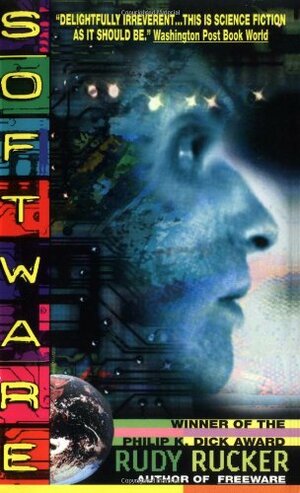
From Storygraph:
“It was Cobb Anderson who built the “boppers”-the first robots with real brains. Now, in 2020, Cobb is just another aged “pheezer” with a bad heart, drinking and grooving on the old tunes in Florida retirement hell. His “bops” have come a long way, though, rebelling against their subjugation to set up their own society on the moon. And now they’re offering creator Cobb immortality but at a stiff price: his body his soul…and his world.”
1. Hep lingo. Like pheezers. Short for “freaky geezers.”
2. There’s a random gay robot.
3. These are some of the most assholish characters I’ve ever read, and I’m here for it.
Set in the distant year 2020, old people (pheezers) have been sequestered into communities in Florida, waiting to die if they can’t get new organs. Our first main character, Anderson Cobb, is the founder of modern robotics, the one who gave the “boppers” the ability to evolve their programs into true sentience.
As “thanks” they’ve offered him robotic immortality in his old age. All he has to do is meet them on the moon. Except the moon is on the verge of robot civil war!
Sleezey. Full of sex and drugs and violence. This is a all-around cyberpunk work before the genre took off into what it is today. Brilliant in its lack of intelligence. Totally blunt in its approach to conversations around identity.
Really just looks you dead in the eye and goes “Look at these cool-ass robots. What if you were one of them?” yet leaves you with the suspicion there’s something more under the surface.
Far Sector
N.K. Jemisin and Jamal Campbell
Sci-fi, political, mystery (2020)
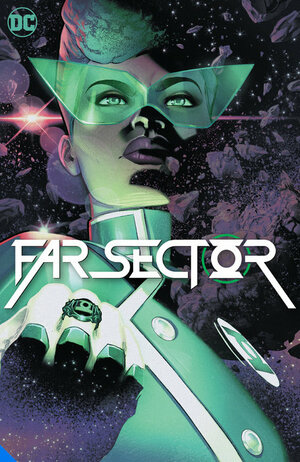
From Storygraph:
For the past six months, newly chosen Green Lantern Sojourner “Jo” Mullein has been protecting the City Enduring, a massive metropolis of 20 billion people. The city has maintained peace for over 500 years by stripping its citizens of their ability to feel. As a result, violent crime is virtually unheard of, and murder is nonexistent.
This mini-series follows newish Green Lantern Sojourner as she goes to the far reaches of space to solve a murder mystery among an artificially peaceful triumvirate of species. What unfolds is a complex political drama.
When a prominent typically non-comic author works on a story like this you have to sort what is purely the author, what is handed down from DC editorial, and how many restrictions were handed down by the Green Lantern lore.
Lantern Sojourner is one hundred percent Jemisin, and she, as a character, is the strongest element of the whole of the story, her design by Campbell included. All the alien designs are interesting and well-considered. I’m now haunting Green Lantern releases to see if any of them will reappear in a more complex capacity, particularly Sojourner.
The overall plot and some of the finer points of the setting however, definitely feel like they suffered from a lack of adequate scope. Under the initial murder mystery, it’s a story about the commodification of creativity with a little bit of a nod to gold farming. The species of this alien triumvirate have installed this physiological component that “removes emotion.” I don’t know that that reads, necessarily, in the way the characters interact. I feel like that would have a lot more knock-on effects than what we actually see in the story and the setting.
And because these aliens don’t have any emotions, they aren’t able to create media (this is very nebulous), but very specifically….memes. They can’t create…memes. And here, memes are the backbone of one of the sub-economies. So there’s meme-based poverty. And I think the reason this specific little thing bugs me more than the rest is because I feel like it’s a conceit that doesn’t actually understand what memetic propagation actually…is…From like a Dawkinian perspective.
The idea of trading in memes. Of a meme stock exchange. Of some of the other things that happen around black market memes. It’s all a little bit absurdist, but there’s not really room in the story for that social farce to breathe.
It really feels like the higher potential of the story has been significantly dumbed down, though. Jemisin is such a high-concept writer that it almost feels like she got squished into a box. So it’s all still great because it’s Jemisin but it doesn’t feel like she’s been allowed to go full throttle.
Little Fuzzy
H. Beam Piper
Sci-fi (1963)
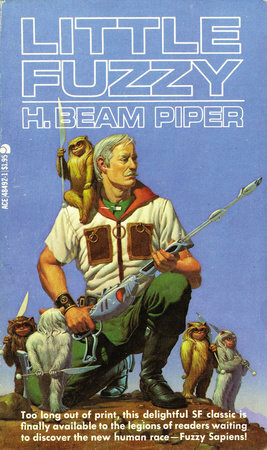
From Storygraph:
The chartered Zarathustra Company had it all their way. Their charter was for a Class III uninhabited planet, which Zarathustra was, and it meant they owned the planet lock stock and barrel. They exploited it, developed it and reaped the huge profits from it without interference from the Colonial Government. Then Jack Holloway, a sunstone prospector, appeared on the scene with his family of Fuzzies and the passionate conviction that they were not cute animals but little people.
This is one of those books that the instant I heard the name it both sounded strangely familiar and like something I needed to read immediatly, so I tracked down a thrifted copy and let it sit on my shelf for a moment while I found a good mental slot for it. I read a lot of books from tehe 50s and 60s, and this felt like one of the slower ones. A little bit from the general pacing and language, a little from how much happens in comparison the book’s size. Even for a short book, there’s a lot of day-to-day ephemera that can drag it down a little.
But it’s that day-to-day stuff that actually forms the foundation of the book. The narrative is basically just Jack observing this new species he’s encountered on an alien planet, the Fuzzies. So it’s very contemplative in that regard. This is, also, a book about the nature of sapience, which isn’t a terribly uncommon theme in terms of both alien and computational thinking. This is one of the very early ones, though that really digs down into it, so it’s able to set a lot of precedents for how we handle it in the future.
One of the unique angles it takes on the idea, though, is from the legislative perspective. How do you legally define sapience for the sake of commercial interests on the planet? And that’s where the meat of the story really is.
Comic Roundup
Web of Spiderverse: Fresh Blood is the start of the next major Venom vs Spider-Man crossover event. So while I haven’t really bothered keeping up with 616 Spider-Man, I obviously needed to snatch it up. And gosh! GOSH GOSH! How FUN. It only presented three variations on Spider-Man, but how FUN. I’m now in desperate need of a Mary Jane: Vampire Hunter comic. Maybe when she’s done being Venom.
X-Men: Krakoa Era
I had been staying up to date with the current From the Ashes Era, but then they went and cancelled X-Force and I had to temporarily drop Uncanny. I decided it would be easier to come back and read them in bigger batches through MU. At thge same time, I thought it would be fun to actually go back and read through the Krakoa era while I waited for that to all gather up. I had already read the Deadpool run from the era and a little way into Marauders. I wanted to read it in the recommended order, so I started with the HOX/POX back and forth.
It’s real fuckin’ weird, y’all. I don’t think I realized just how weird Krakoa actually was. From a comic construction perspective, though, I really find it fascinating how they seem to be managing to tell this big overarching, epic story. It’s very ambitious.
From there I got into the first arc of New Mutants, took a second look at the recommended reading order, and decided I would come back.
Deadpool
After jumping off Krakoa, I got caught up with the current Deadpool run. Then I was like, you know what? Let me go back a little bit. So now I’m working through the Joe Kelly run from the late 90s, and it’s….very 90s. I’m really enjoying the number of “product of its time” warnings that are popping up. But it’s also fascinating to have these bookends right next to each other to see how this character has evolved.
Metamorpho
So here’s the thing with Metamorpho now that I’m five issues in: you’re either going to “get it” or you’re not. I’m coming to find that I just seem to have a very similiar humor to Al Ewing, and it’s really paying off for me. Because Ewing’s in this position where he’s writing a silver age…that’s self-aware. It’s a comic that knows it’s a comic, and damn it’s good if you’re really in-synch with the writing.
Venom Chronological Read-through
I’m officially through the “Agent Venom on Earth” era, about to enter into Venom in Space with his Guardians of the Galaxy tenure. The more I think about Flash as host, the more I think about little they really do with the symbiote, sepcifically, in this era, considering how many years it goes. The Hellmark actually being a deal with the symbiote and not Flash is the most interesting thing, and it’s literally a throwaway panel. Andi as Mania is the next most interesting part, in regards to symbiosis, and her story’s very compressed.
So it’s one of those things where the story itself is excellent. The writing is fantastic. But comparing it to canon so far, sometimes it just feels like Flash with powers that sometimes make him a little crazy. With the symbiote being basically sedated through most of these runs, the actual symbiote story is a little weaker (except when Eddie’s on page.)
