
Childhood’s End
Arthur C. Clarke
Science Fiction, 1953
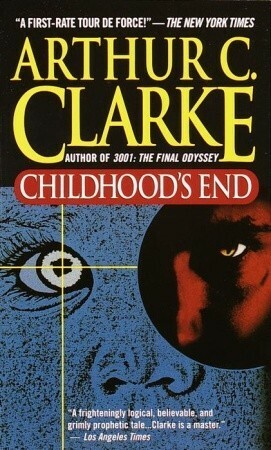
From Storygraph:
In the near future, enormous silver spaceships appear without warning over mankind’s largest cities. They belong to the Overlords, an alien race far superior to humanity in technological development. Their purpose is to dominate Earth. Their demands, however, are surprisingly benevolent: end war, poverty, and cruelty. Their presence, rather than signaling the end of humanity, ushers in a golden age . . . or so it seems.
Without conflict, human culture and progress stagnate. As the years pass, it becomes clear that the Overlords have a hidden agenda for the evolution of the human race that may not be as benevolent as it seems.
This was a reread of something I read literally fifteen years ago. When I realized I couldn’t remember anything about the story except some broad beats, I knew it was time.
When you’re approaching a book like Childhood’s End, you have to remember it’s being written by a white man in the fifties with all the trappings therein. In this book, Clarke was trying to hypothesize, to some degree, a post-racial society, so you can kind of imagine how stumbling and awkward those particular details are. You kind of just have to slide over that.
Because underneath that (which was not intentional, considering the source) is a sort of deconstruction of the white man’s burden. These aliens, The Overlords, arrive on Earth, and their goal is to elevate humanity into a new utopia. That’s their job. The weight they carry on their shoulders. This interleaves with an examination of the supernatural, of our place in the universe, and the relationship between art and suffering.
This is one of those books that might feel a little less accessible to newer science fiction readers, so they might seek out the mini-series adaptation. While I find the mini-series a bit slow, it does mostly cover the beats of the main narrative. That could be a useful tool when working through the book, namely, knowing what happens next.
The problem is, they’re kind of telling two different stories based on the same skeleton. It’s one of those adaptations where you lose a lot of the original intentions of the book for the sake of a cleaner narrative and more mainstream appeal.
So that’s a bit of a “your results may vary” situation.
Night’s Master
Tanith Lee
Mythic Fantasy, 1978
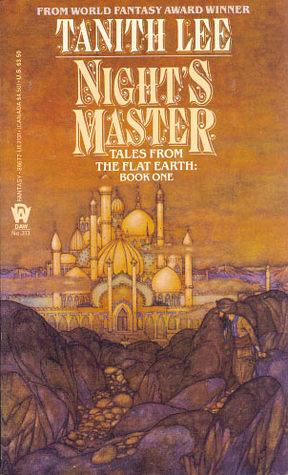
From Storygraph:
Long time ago when the Earth was Flat, beautiful indifferent Gods lived in the airy Upperearth realm above, curious passionate demons lived in the exotic Underearth realm below, and mortals were relegated to exist in the middle. Azhrarn, Lord of the Demons and the Darkness, was the one who ruled the Night, and many mortal lives were changed because of his cruel whimsy. And yet, Azhrarn held inside his demon heart a profound mystery which would change the very fabric of the Flat Earth forever…
It’s been a couple of decades since I read Tanith Lee, so when I found a three book compendium in a thrift ship in Colorado over the summer, I thought it was a great time to get back into her.
What a wonderful ride. Mythic fantasy with the bend of an ancient fairytale, it slips through connected stories about the machinations of the Prince of Demons, Azhrarn. This is the structure of narrative you’d see in something like 1001 Arabian Nights or Le Morte d’Arthur and would be favored by a reader who enjoys folklore or epic poetry.
Also, it’s almost a queer book, particularly the presence of a twisted Achillean romance. It plays with the concepts either lightly or in a dark way, but that could almost be a result of the time period. So even if I’m unsure I would push into the category of queer literature from a holistic perspective, it most certainly creates strong narratives outside hetero-normative assumptions. It’s worthy of further comparative analysis with other books from the era, the immediate series, and the world in which the books are set.
Temporary DNF
To Shape a Dragon’s Breath
Moniquill Blackgoose
YA Fantasy, 2023
I don’t tend to talk about books I didn’t care for unless there’s something specific I want to address. With this book, I did want to talk about why I decided to temporarily pull back from it for a reset. A lot of it has to do with the way the world has been built. It supposes a sort of alternative version of our actual world where magic and dragons exist.
One of the things it does is attempt a sort of linguistic reconstruction. Instead of the English arriving in the new world, it’s the Anglish. Algebra is al-jabr, which is the original Arabic word. Geometry is “anglereckoning.” This in addition to some fictionalized words for fictionalized magic craft.
Where I’m stymied is it feels like a very juvenile approach to this concept. And when I say “juvenile” I want to be very clear that this isn’t a quality judgement, necessarily. Rather an indicator of how far down the road this has been thought out.
If you were hypothesizing a totally different evolution of English and German such that it would lead to the creation of these alternate words, then you wouldn’t actually be writing in a recognizable version of English at all. If Greek didn’t exist or wasn’t pulled from to create the word “geometry” (thus the word “anglereckoning”), that would have major knock-on effects for the rest of the English language. So to me it feels like a very cursory approach to the idea that’s really easy to break under just a little bit of examination.
At the same time, this is a young adult novel, and that’s actually an important variable. The main character’s fifteen. Considering how these book age groups tend to fall out, this could be aimed at kids as young as thirteen. For the average reader of that age, they probably wouldn’t overthink these elements. And what feels surface level to me might feel like a good introduction to linguistic world-building for someone else.
Especially considering I don’t particularly care for hard-magic systems anyway and highly favor super organic world-building. So I’m stuck in a place where I wouldn’t mind seeing how the story evolves, but I’m getting really caught up on what feels like overly stilted language.
Comic Roundup
Venom
I’ve started into the Flash Thompson era of my Venom chronological re-read, and this is actually where I’m getting into some things I haven’t actually read, yet. Flash finds himself on the Secret Avengers, The Thunderbolts, and The Guardians of the Galaxy, and I had just never read those team books.
I just finished Remender’s first run on the main Venom comic of the era and then Secret Avengers. Now having just read Remender’s Uncanny X-Force, I feel like I’m developing a sense of how this man approaches macro storytelling. He tends to monologue for extended lengths of time in this sort of breathless, snipped manner. I can also feel a pattern to the way he escalates the main plot, but I’m still working on diagramming it. My first draft is basically:
-fucked up thing 1 happens, but they deal with it
-the story branches a little
-then major fucked up thing 2 happens that takes up the rest of the story
-buncha super weird shit that doesn’t seem immediately relevant happens
-oh wait, it WAS relevant hahah ah fuck you
-that all collapses back on to reveal more information about fucked up thing 1
And I feel like in the “buncha super weird shit” section things get a little long in the tooth, but the payoff usually ends up being mostly worth it. We’ll see if I notice this pattern continuing.
Moon Knight
I’ve also been reading Moon Knight. I started with the highly recommended Ellis run which then moves into Wood and Bunn (2014-2015). This is exceptional story-telling with absolutely phenomenal artwork. The way it uses the white of Moon Knight on these hyper-saturated environments is beautifully uncanny. I have a very cursory understanding of the character, mostly gleaned from the TV show and follow-up research. This was an excellent run to bridge into the comics coming from that background.
Then, for fun, I read the Bendis run (2011-2012) simply because everyone in the fanbase seemed to hate it. And I get it. The story itself was a lot of fun. I was entertained. But even with my limited experience with the character, I could tell it wasn’t super authentic to how the character had been previously written. So while I found the idea of Marc’s alternate identities being Captain American, Spider-Man, and Wolverine being interesting, it really felt outside the scope of the character.
Currently I’m working through the Moench run from the 80s, and it’s a ride. Three times now I’ve gotten the “hey this comic has some insensitive stuff in it” warning just to be followed by some pretty racist or sexist shit. But these warnings are actually more interesting when considering the presence of a black supporting cast. It’s a single mom who’s a waitress and her two teenage boys. Now while the single black mom is super cliche, obviously, we are looking at a comic from the 80s. The characters themselves, however, are depicted in parity with the rest of the cast. Much of the racism is more in the way the villains are depicted. It’s just an interesting insight into Moench’s thinking process and the evolution of how we analyze and interpret non-white characters in media.

 Pixels and Pins Studio