
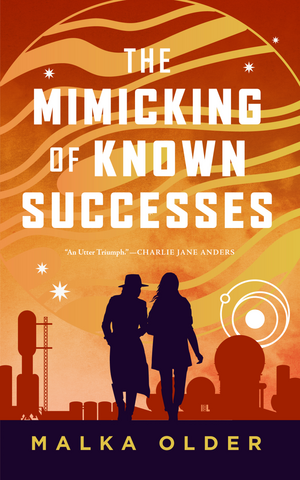
The Mimicking of Known Successes
Malka Older
Cozy Science Fiction-2023
From Storygraph:
“On a remote, gas-wreathed outpost of a human colony on Jupiter, a man goes missing. The enigmatic Investigator Mossa follows his trail to Valdegeld, home to the colony’s erudite university—and Mossa’s former girlfriend, a scholar of Earth’s pre-collapse ecosystems.
Pleiti has dedicated her research and her career to aiding the larger effort towards a possible return to Earth. When Mossa unexpectedly arrives and requests Pleiti’s assistance in her latest investigation, the two of them embark on a twisting path in which the future of life on Earth is at stake—and, perhaps, their futures, together.”
This is one of those books where I go, “oh, maybe this specific sub-genre of sci-fi isn’t actually for me.”
I didn’t dislike it by any means. I found it to be a really great read for a camping trip we were on at the time. But it is one of those books that points out to me how much different my brain functions when I’m reading science fiction compared to other genres. We’re presented with this colony on Jupiter and this complex ring-rails system. There’s this the implication of some kind of genetic bank sitting around somewhere. There’s all this biological and ecological engineering happening in the background.
And very little of those specific elements are explored.
So I’m sort of driving myself crazy, desperate to know about this very interesting sci-fi concept. And it’s just…not there. But that’s also not really the “fault” of the book because that’s not what the book is actually about. It’s a cozy gaslamp romance mystery…that happens to be science fiction. The mystery is strong. The romance has a very light quality to it, but it’s threaded throughout.
It raises the question of “who do you sell this to and how?”
And whatever the strategy was, it worked. It gained enough momentum in the cozy community that it broke containment, and I picked it up myself. Overall, though, I enjoyed it, I just don’t know how much of an area this is for me, personally.
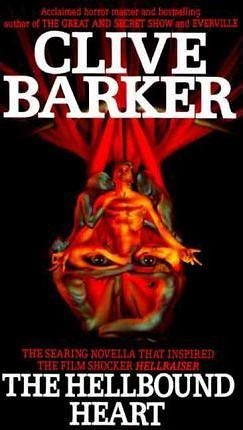
The Hellbound Heart
Clive Barker
Horror, 1986
From Storygraph:
“…a nerve-shattering novella about the human heart and all the great terrors and ecstasies within its endless domain. It is about greed and love, lovelessness and despair, desire and death, life and captivity, bells and blood. It is one of the most dead-frightening stories you are likely to ever read. “
I really should have started reading Clive Barker a long time ago considering how much I love his work as a director and in other mediums. It is what it is!
When I finished The Hellbound Heart, I suddenly realized it had been a good decade since I’d seen Hellraiser. It was a perfect time for a rewatch. I don’t think I ever fully appreciated how faithful the movie adaptation is to the book. The way it transposes the textual dread into this visual horrorscape is just such a perfect example of how to do this. And the older visual effects just make that better.
I also noted two changes that I thought were particularly interesting. Changing Kirsty from just a friend to Rory’s/Larry’s daughter makes all the relationship dynamics so much better and really elevates just how creepy Frank is with her.
But there’s also this tonal change to the Cenobites at the end. Having only seen the movie ’80s movie, I was a little surprised by what I read almost as sympathy right at the end of the book in dealing with Kirsty. She has the puzzle box by accident, and I feel the Engineer was reluctant to do their job in that moment. I sensed an implicit sigh in the dialogue. All connecting to the fact they give her the box back. It’s such a different set of characters in the movie in that particular set of scenes.
With Barker still being in charge of the project, though, it does feel like a decision he okayed. I keep meaning to dig into this decision more, because I’m certain this difference has been discussed somewhere.
This Month’s Comic Reading
With the end of Venom War, I’ve moved on to the next All-New Venom storyline. Only one issue, and I’m still excited to see where the story goes.
This month I finished, via omnibus, Cable and Deadpool (2004-2008). They actually totally loose Cable in the last quarter of the run, and it’s kind of funny to see how the story sort of devolves then quickly re-evolves to make up for this gap. I think Cable generally has the problem that he can get a little stuck as a character, and this run fell into that same pattern.
But I was really really impressed with the sort of incremental change in Wade’s character over the entire four year span. It’s this very bit by bit progression of tiny little changes to his outlook on life and relationships that feels very natural. And there’s this visual mirror between the very very first page of the run and the last that is just really exquisite.
I’ve also continued my re-read of the entire Venom main story chronology. This month, I finished the Mac Gargan era and started moving into the Anti-Venom storylines. This included, among other things, Thunderbolts (Ellis and Deodato, 2006) and Dark Avengers.
Reading Venom’s tenure in the Thunderbolts at roughly the same time as Cable and Deadpool ended up being an excellent idea, even though it was totally unintentional. And that’s because they both overlap with the Civil War crossover event and all the fallout from it.
In one narrative it’s Deadpool hunting down unregistered supers for the government because he’s loyal to Uncle Sam. Then in this other narrative we’ve got Venom, as part of a team, also hunting down unregistered supers because they’ve got no other choice and hey, bonus, gets to eat people maybe. So what we have is this comparison between two people attempting to do the same thing coming from a completely different ethos with totally different techniques.
When I read bits of Mac Gargan before, it was out of order and lacking a little bit of the extra context around what the lore was looking like at the time. This time, coming at it in order, I enjoyed it a lot more. That villain as protagonist story can be tricky, and this particular era is especially villainous. In one of my comic groups, someone else had read this era of Thunderbolts recently, as well, and they felt disappointed there wasn’t a redemption arc for any of the characters. For me that was a feature, not a bug, considering what was happening in the rest of the lore, at the time.
This was a team of Thunderbolts formed during Civil War, when suddenly a number of once-heroes are now traitors to the US government and need to be tracked down and imprisoned. So we have this arc of instead a villain becoming a hero because of their own actions, we have a bunch of characters making this switch because the world has changed around them. The social circumstance of the time have turned these bad guys into good guys through propaganda instead of personal sacrifice. When you look at it from that perspective it’s a much more fascinating story arc than your standard redemption.

 Pixels and Pins Studio