
Blindsight
Peter Watts
Science Fiction-2006
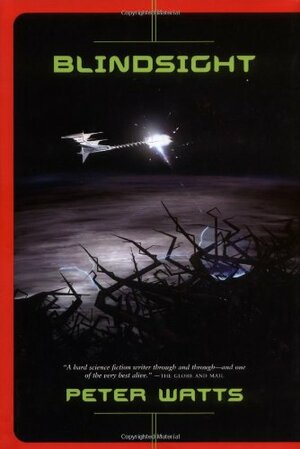
From Storygraph:
“It’s been two months since a myriad of alien objects clenched about the Earth, screaming as they burned. The heavens have been silent since – until a derelict space probe hears whispers from a distant comet. Something talks out there: but not to us. Who to send to meet the alien, when the alien doesn’t want to meet? Send a linguist with multiple-personality disorder, and a biologist so spliced to machinery he can’t feel his own flesh. Send a pacifist warrior, and a vampire recalled from the grave by the voodoo of paleogenetics. Send a man with half his mind gone since childhood. Send them to the edge of the solar system, praying you can trust such freaks and monsters with the fate of a world. You fear they may be more alien than the thing they’ve been sent to find – but you’d give anything for that to be true, if you knew what was waiting for them.”
This was sold to me as a vampire alien book. Two of my favorite things. This was not quite how the story unfolded.
I feel like understanding Blindsight starts with its world because that’s ostensibly where the point of the story lies. It’s a philosophical conversation through the an examination of the world it speculates. So we have a future where computer technology and has advanced to the point a where you can upload your consciousness to a computational cloud and interact, at a cortical level, with spaceships. We have bases on the moon. We genetically manipulate our children as embryos. We can graft multiple consciousnesses onto one brain. Vampires existed at one point, and we’ve brought them back through genetic engineering.
On top of this template, the human race is faced with a new Unknown from beyond the stars, something that’s communicating with something else outside the solar system. Our main character (who strikes me as autistic-coded), is hand-picked for the mission to turn out the source of the threat.
While there are a lot of harrowing moments, you have to come into this book expecting what amounts to a series of philosophical musings. Not a lot necessarily happens as far as beats of plot. Rather, what we find is a study of the characters’ reactions to the things that do occur. And those reactions then create a tense conversation about intelligence, evolutionary theory, consciousness, social connection, and neurodivergence.
The ending leaves a considerable open space, our main character aware of some great disaster happening on Earth, but unable to do anything about it. While the follow-up book seems to dig into this, it’s also a comfortable place for the book to end with a sense of mystery, even if it leaves other things unsolved.
This book is available online for free under a CC license.
Deadpool: Back in Black
Cullen Bunn (writer), Salva Espin (illustrator)
Comic Trade Paperback-2016
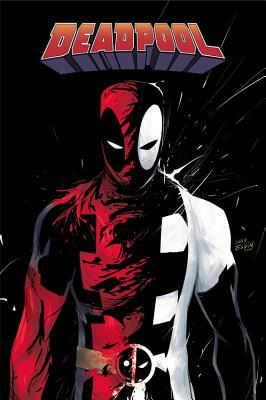
From Storygraph:
“During 1984’s SECRET WARS, Deadpool was introduced to an alien symbiote who went on to become Spider-Man’s black costume and, eventually, Venom. OK, OK, maybe that really happened in DEADPOOL’S SECRET SECRET WARS. Point is, did you know that after Spider-Man rejected the costume…it went slinking back to Deadpool on the rebound? And they went on adventures together? You didn’t? Well, you will, now, thanks to this series by Cullen Bunn (The DEADPOOL KILLOGY) & Salva Espin (DEADPOOL & THE MERCS FOR MONEY)
COLLECTING: DEADPOOL: BACK IN BLACK 1-5″
I got a Marvel Unlimited subscription, so this is the new era of my life.
Thing is, I genuinely love superhero comics and the lore they exist in. It’s just a lot. That’s kind of why I really really enjoy these short mini-series that you can almost read by themselves. I like Deadpool. I love Venom. And I’ve generally enjoyed Cullen Bunn. So this was a an obvious choice to dig into.
The premise plays on this sort of pseudo-canon tidbit that the Venom symbiote actually bonded to Deadpool between Spider-Man and Eddie Brock. So what you have is a Deadpool with Spider-Man powers sharing control of his body with an alien symbiote.
So it’s that character going through a series of missions with escalating silliness. He fights both Kraven and a horde of murderous bunnies.
So it’s mostly just a lot of fun. But then there’s this really great mid-point where the symbiote properly emerges and has a real voice for the first time. And it’s like…oh…And now you’re a bit worried for Wade Wilson. It adds this sort of unexpected edge to what’s been a generally working relationship.
It’s just a good, short series read with goofy action, interesting characterizations, and a great use of meta-textual humor.
In the Watchful City
S. Qiouyi Lu
Sci-fantasy-2024
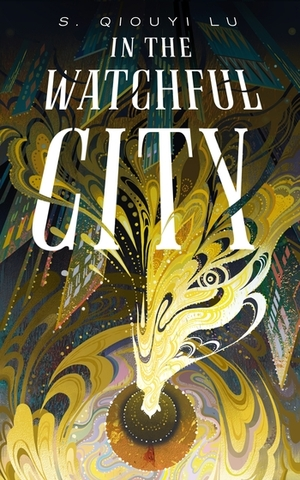
From Storygraph:
“The city of Ora uses a complex living network called the Gleaming to surveil its inhabitants and maintain harmony. Anima is one of the cloistered extrasensory humans tasked with watching over Ora’s citizens. Although ær world is restricted to what æ can see and experience through the Gleaming, Anima takes pride and comfort in keeping Ora safe from all harm.
All that changes when a mysterious visitor enters the city carrying a cabinet of curiosities from around the world, with a story attached to each item. As Anima’s world expands beyond the borders of Ora to places—and possibilities—æ never before imagined to exist, æ finds ærself asking a question that throws into doubt ær entire purpose: What good is a city if it can’t protect its people?”
Since finishing this, I’ve been trying to decide how to describe it and if I even wanted to talk about it. And that’s because if I didn’t particularly care for a book, I just assume not draw attention to it. But let me describe this book with the hope I can find its audience.
It’s a series of vignettes connected by an overarching story about a being (presumably human in nature) who is able to connect to a city-wide biological grid as its caretaker. Ae can see through all the eyes of the city and interact with it at a base level.
Where I found myself in conflict with the book, is as each vignette ended, I couldn’t figure out what the author was actually trying to say. Not that the text was confusing. Far from it. But rather with some stories I was left with a feeling of “what was the point of that?” And with others I felt as though the allegorical synthesis was either inconsistent with itself or didn’t lead anywhere.
Which is all a bit of a shame because the characters are interesting, the what-ifs are intriguing, and the prose is very lyrical and engaging.
So I’ve decided the problem is likely just my interaction with the text and, more importantly, my experience and relationship with esoterica, weird fiction, and extended media metaphor. Basically, I’ve watched and read a lot of weird shit in my day. So I’m having a hard time determining whether I’m looking for something that this book never actually intended to deliver and I’ve mis-cast it. Or I’ve gotten it exactly right, it just didn’t execute to the level I would have expected. I basically can’t determine this beyond “I suppose it’s just not for me,” so I would encourage others to look into it themselves.
Moths
Jane Hennigan
Sci-fi, Apocalyptic-2021
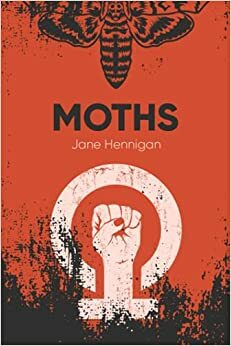
From Storygraph:
“All across the world men are turning into crazed killers or dying in their sleep, as toxic threads find passage on every breath of wind.
‘Out they came, away from natural predators, nesting in damp corners and in the tops of trees, crossbreeding with common cousins and laying thousands upon thousands of eggs. Then… the eggs hatched and an army of hungry caterpillars spread their tiny toxic threads on every breath of wind.’
The threads spell doom for humanity – half of it, at least. All around the world, men are dying in their sleep or turning into rage-fuelled killers. The world as we know it, ends. However, humanity adapts and society moves on.
Many years later, very few even remember what life was like before the change. Mary does, though, and when an opportunity presents itself, she is faced with soul-searching decisions to make. Will she cling to the only strand of the past she has left or will she risk it all in the name of equality?”
I talked about this book on TikTok and a mutual commented something to the effect of “ngl, this is the worst book I’ve ever read.” And I literally had no idea what to do with that, because I cannot figure out where that sentiment comes from for this particular piece of media. But whatever.
This book sets up an apocalypse caused by an insect-born virus. This virus only affects “biological men” (we’ll come back to this) and either kills or turns them into homicidal maniacs. This persists into a future forty years down the line where men have to be kept in isolation for the health and safety of the entire species.
This does suffer under some of the same trappings that this kind of story presents, ie struggling to think outside the gender binary. I feel like it has an awareness of this, though, and tries to address it through the inclusion of a trans-woman character in the past. I find myself reading this as a metatextual conversation about the way society struggles to see outside the gender binary. As a non-binary person myself, it still does strike as “cis-woman doing her best,” but I can just kind of let that go to permit the rest of the conceits of the story.
So I really enjoy how this book sets up sort of two POVs of contrasting women. One had men very centered in her life at the time of the end of the world, one, as a lesbian, didn’t. They found themselves within different strata of the patriarchy, and that carries over into their reactions and actions in the “current day” of the book.
I do also find the way Hennigan set up the matriarchy of the future to be very intriguing. In that it doesn’t necessarily come from a feminist perspective, but rather an examination of gendered power structures. Because we see here a society run by women in which men are quite literally wholly dependent on female production. They, by their current nature, have to be monitored and controlled. And it’s so easy to see how that could bleed into subjugation no matter the gender on either side of the power structure. So it ends up being a very interesting conversation about what gender equity and equality actually might break down into depending on variation on social structure.
This Month’s Comic Reading
Earlier this month (with the third movie bearing down on me) I decided to do a chronological read/re-read of all the major appearances of Venom starting with his solo work, skipping a few things I didn’t feel like re-reading.
Now keep in mind, I already know Venom lore backwards and forwards, and if there is a factoid I don’t recall off the top of my head, I know which comic to go to. But there are some small chunks of story I’ve never bothered reading myself, and I’d never done it in order.
So this month I worked from Lethal Protector of 1993, through all the nineties mini-runs, the Daniel Way run of 2003, Venom vs. Carnage and the birth of Toxin, ending right at the transition to Mac Gargan as Venom in 2004. Most of this was re-reading or finishing series I had started and DNF’d. The Madness and The Hunger are two of my favorite mini-series, and I reread those all the time.
What’s most fascinating doing this, is you can map the prevailing mindset of Marvel editorial in relation to this character through the years. They spend seven years building this character into what ends up being a very complex protagonist (for the 90s). Really on his way to being a true Racinian anti-hero. Then they just kind of gave up. They made him a villain again by rewriting and reframing a bunch of the Venom symbiote’s motivations and setting up the narrative hooks to get rid of Eddie in a comic book permanent way.
Knowing what happens going forward, they also set up a number of things in the early 2000s that I know never end up going anywhere or get retconned a few years later. So combine that with the birth of Toxin (the first spawn in a few years at that point), I can retrospectively guess they were trying to slide Toxin into that anti-hero slot, and pull Venom back into the rogue’s gallery. And it just kind of didn’t work?
Next is going to be the Mac Gargan era and the creation of Anti-Venom, which I’ve read the least of, so it’ll be an interesting through line and transition into Agent Venom later.
I also read the ‘24 Separation Anxiety mini-series by Micheline which tells a retro-story of Venom and Eddie from their lethal protector era. It’s A LOT of fun seeing a new take on that time in their life with modern sensibilities.
Keeping up with the Venom War event and the current Ewing run has been absolutely delightful, and I’m antsy to see how it ends.

 Pixels and Pins Studio