
We’re a few weeks out from the release of Brand New Day. I thoroughly enjoyed the movie and thought it had wonderful performances from everyone involved. At the same time, I find it terribly frustrating.
On Threads, my “hot take” was that Jean Grey was being shoved into a narrative that didn’t have enough room for her. In a broader sense, both my husband and I independently agreed that she didn’t feel like Jean at an existential level. He’s really only familiar with her through the first set of Fox films, the 90s animated show, and its continuation through ’97. I have all that, more movies, shows, and the paired comic knowledge.
And we’re not the only ones to feel this way about Jean, but it is a minority opinion in all the comic spaces I’m in, right now. This is part of a Thread I screen captured this week.

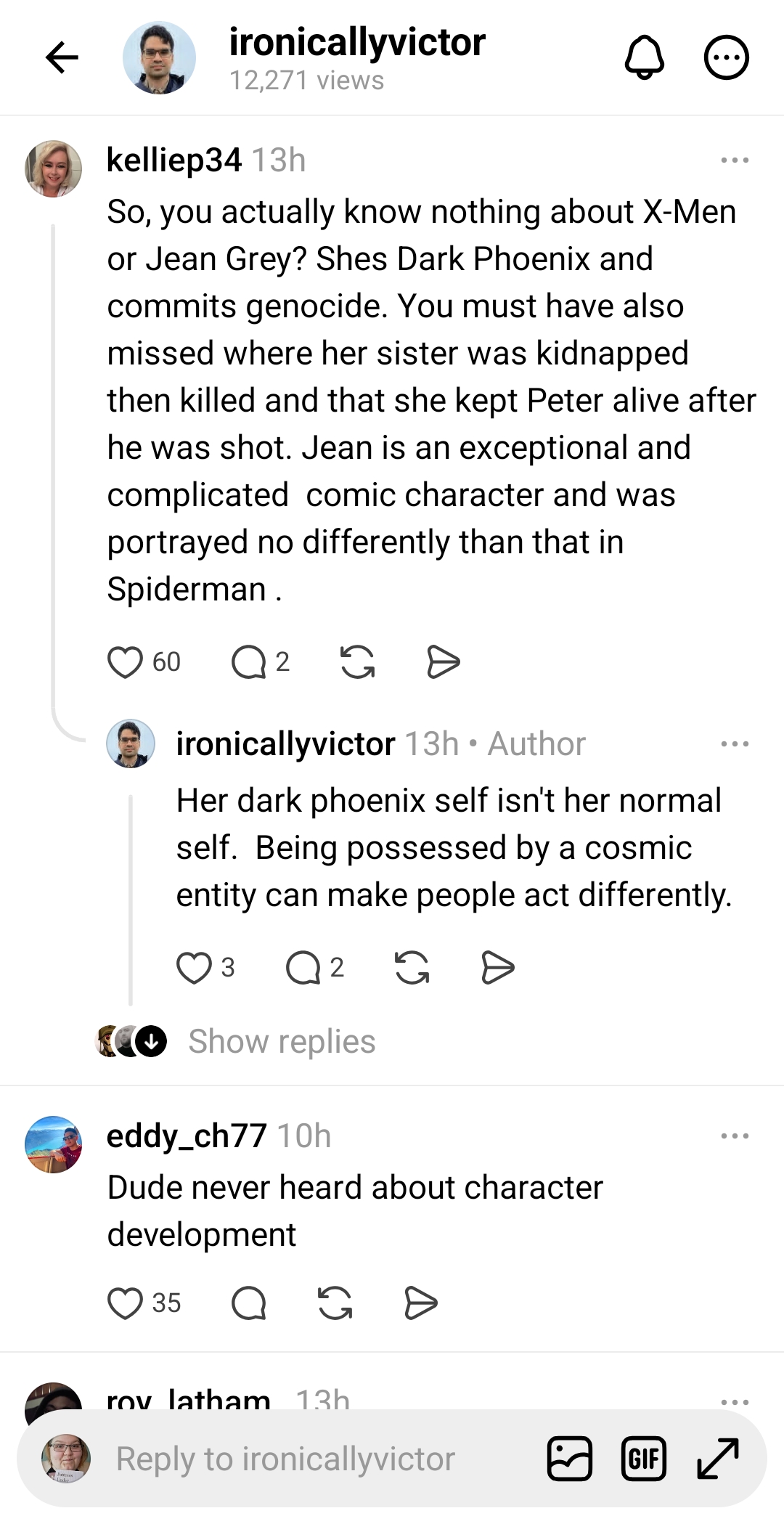
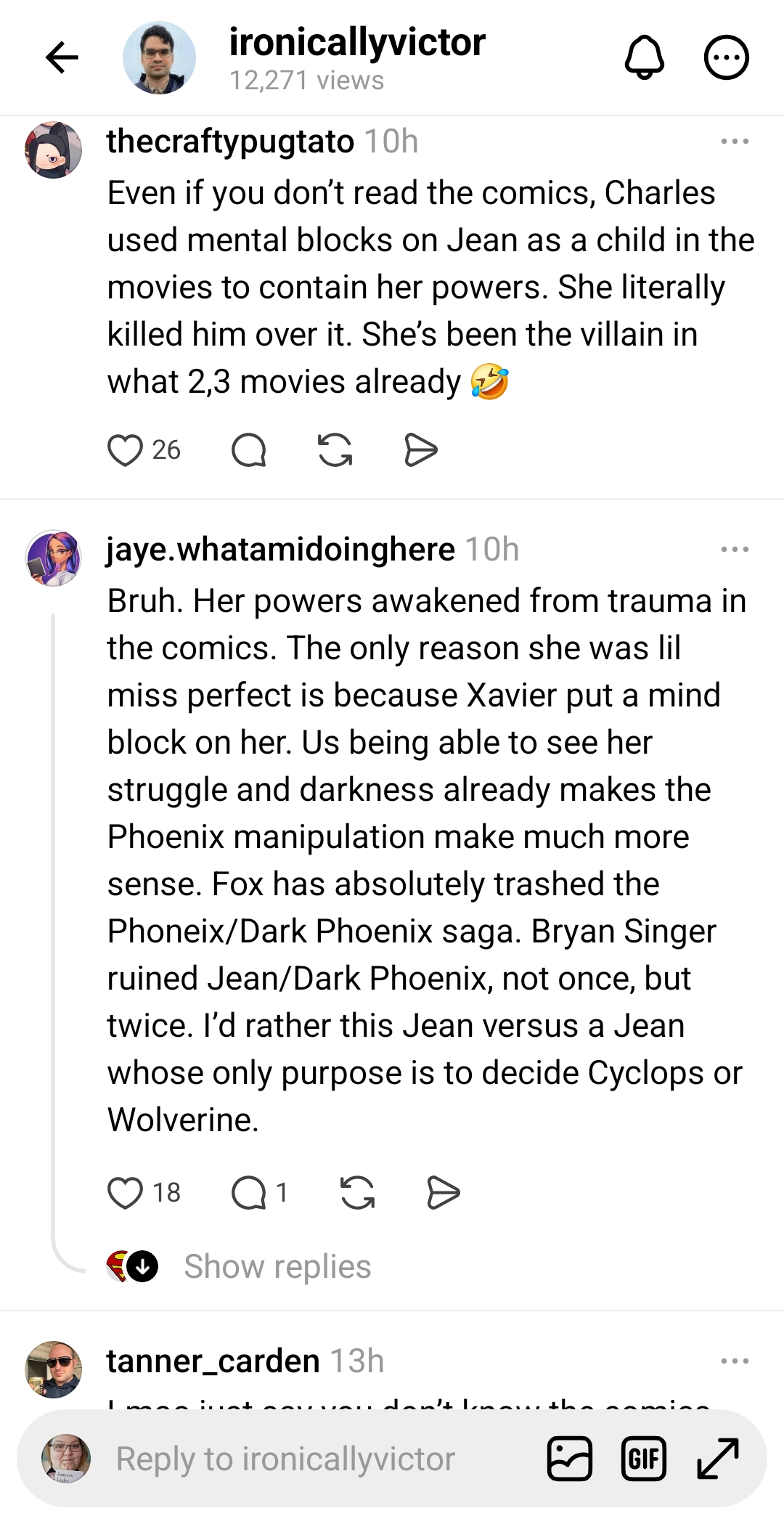
Now I don’t totally agree with the top poster’s assessment of Jean. It’s only really captured part of who she is. But almost every single time I’ve seen someone voice the opinion that Jean as a straightforward antagonist felt out of character, it’s followed by a mass response citing Dark Phoenix or Charles Xavier’s mental blocks. This not only ignores who Jean is outside the Phoenix but also betrays a gap in understanding of what the Phoenix Force looks like in modern X-Men lore.
While it began as a device to make Jean god-like in a way that they could pull back later, the Phoenix Force has come into its own as a grand, sentient cosmic entity. Other people have been the host of the Phoenix Force. One of the recurring themes is that it’s such an overwhelming power, it takes a lot of work to keep from folding under the weight of it. Scott Summers killed Charles Xavier under its influence.
It’s also worth noting that because of some goofy-ass retcons driven by editorial, the Jean Grey who joins the original five X-Men is not technically the same being that eventually dies on the moon. It’s a whole weird thing.
All this to say that between pre- and post- Phoenix Jean, you don’t necessarily have to create a strong continuity of character because in a lot of ways they aren’t exactly the same person. So you don’t have to foreshadow the Dark Phoenix when telling a story about teenage Jean Gray. In fact, the narrative impact of the Dark Phoenix story hinges on its contrast with who Jean is as an Omega-level mutant in her own right and how she first reacts to having the Phoenix Force.
Jean is a brat with a temper, and she’s so powerful Xavier had to put in blocks on her telepathy just so she could function. This mental scaffolding never stopped her from being written as bold, sassy, independent, and extremely assured of her powers. At the same time, she’s also a good guy. She’s a hero. That ambition is what makes her compelling as a character. Despite her occasional temper tantrum, she’s always trying to do good in the end.
When she uses her powers as Phoenix, she expresses hesitancy and concern at just how powerful she is, and her subconscious mind puts up shielding around the bulk of the Force. She develops, into adulthood, a keen awareness of what power actually looks like.
Because of that baseline, when she does push it too far it creates a narrative “oh shit” moment. Other characters in the narrative might question what’s “wrong” with Jean because she’s acting in a way they don’t expect.
Another citation I’m seeing in defense of Jean’s depiction in Brand New Day is All-New X-Men by Bendis. They most often point to a specific scene early in the run where Jean does a bit of a mind wipe on Warren. It’s a “hey look, teenage Jean has always used her powers in an unethical fashion.” But there’s a lot more to this scene and the storyline that it takes place in.
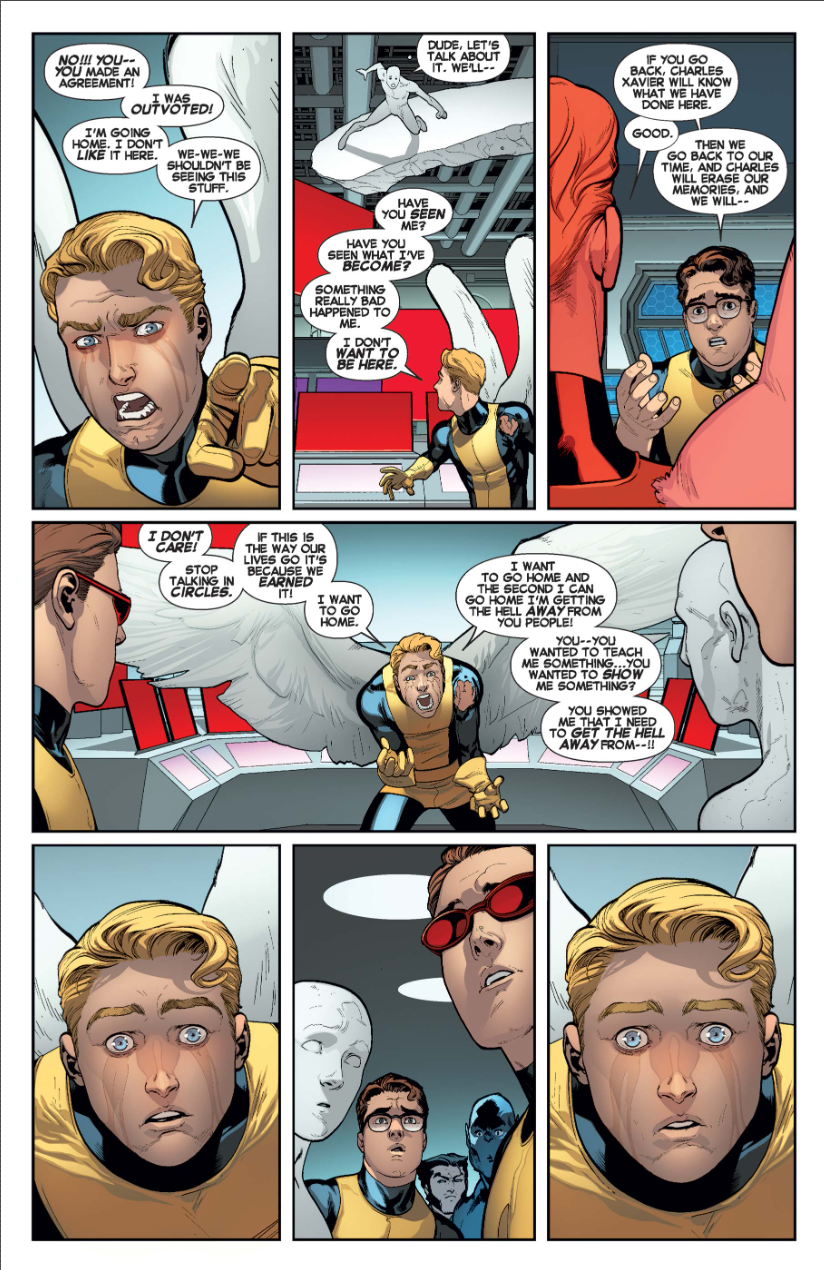
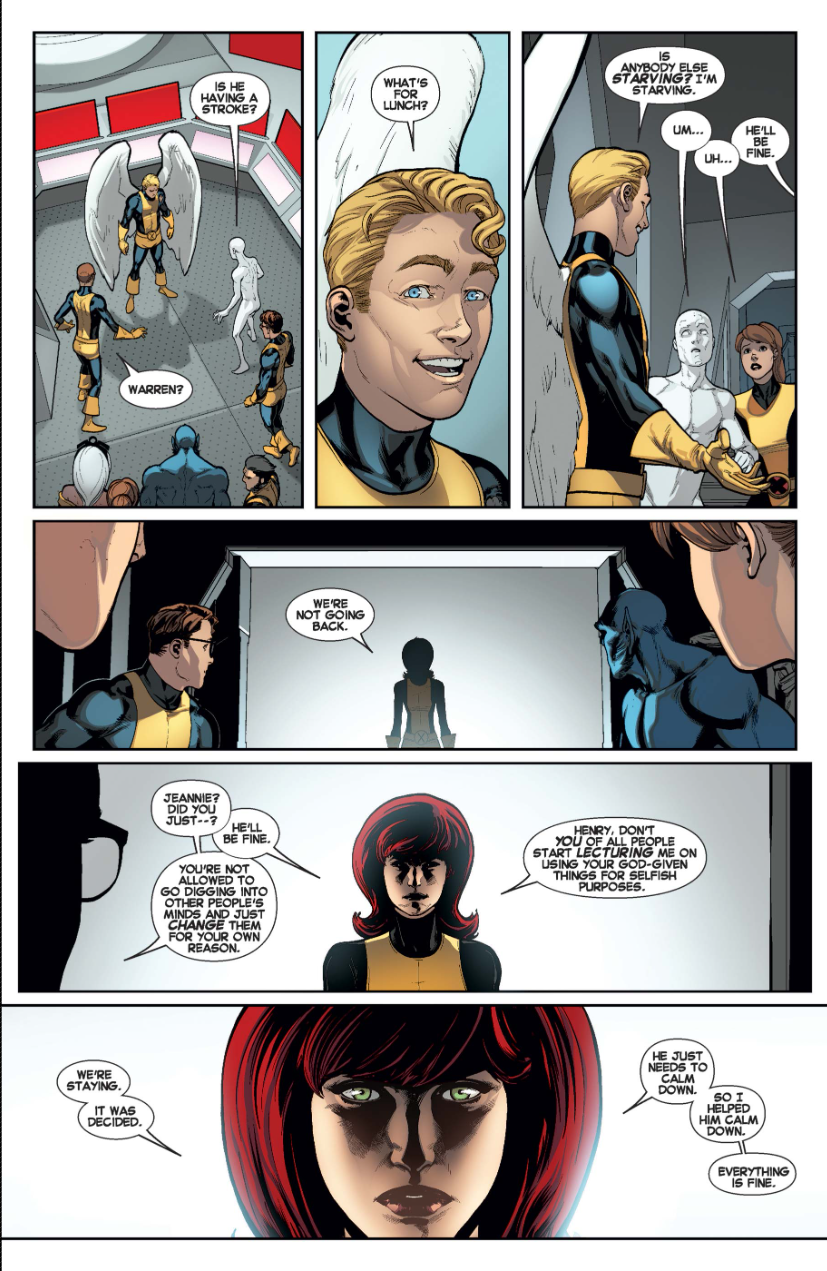
From All-New X-Men #8
This run takes place right after Cyclops, while possessed by the Phoenix Force, kills Xavier. Jean in the present is also currently dead. So now there’s this big schism in the X-Men where Cyclops is working with Magneto and Emma Frost to recruit new young mutants for their competing organization. He’s acting very aggressively and dealing with a lot of grief. Jumping on a throwaway comment from Iceman, Beast decides to bring the original five teen X-Men forward from the past, hoping that if they confront Scott, he’ll start to reevaluate how he’s handling things.
A little bit before this scene the teenagers have a vote about staying in the present versus going back to the past. If they go back to the past, Xavier is going to read all their minds, see that they’ve seen their own future, and wipe their memories. They won’t be able to fix the schism. Warren gets outvoted to stay.
As the story progresses, the teenage X-Men learn more about their future and their lives going forward. In the process, Jean becomes particularly focused on fixing things in the present because she see’s what happens to her. She’s also struggling with having telepathy, again, because she’s out of reach of Xavier’s mental blocks.
In the referred to scene, Warren is losing his shit because he’s seen what happens to his future self, and he cannot deal with it. That’s when Jean comes in and presses the quick restart button in his brain. The unethical element of this is invading Warren’s bodily autonomy. The act itself, however, is an attempt to stay on mission and doesn’t come from a place of cruelty or spite. It doesn’t really hurt Warren, in the end. He feels better afterward.
Compare this to walking a random man into traffic or throwing MJ off a building just to intimidate Spider-Man into not interfering with your half-baked plan to find your sister.
However imperfect it might be, the ratio of “serves a positive purpose” to “intended harm” is vastly different between scenarios and shows completely different approaches to using her powers.
You’ll also note the look of horror on the faces of the rest of the O-5. She has crossed a line they didn’t expect of her. Because she’s generally a good guy who uses her powers for good things. The contrast is the point.
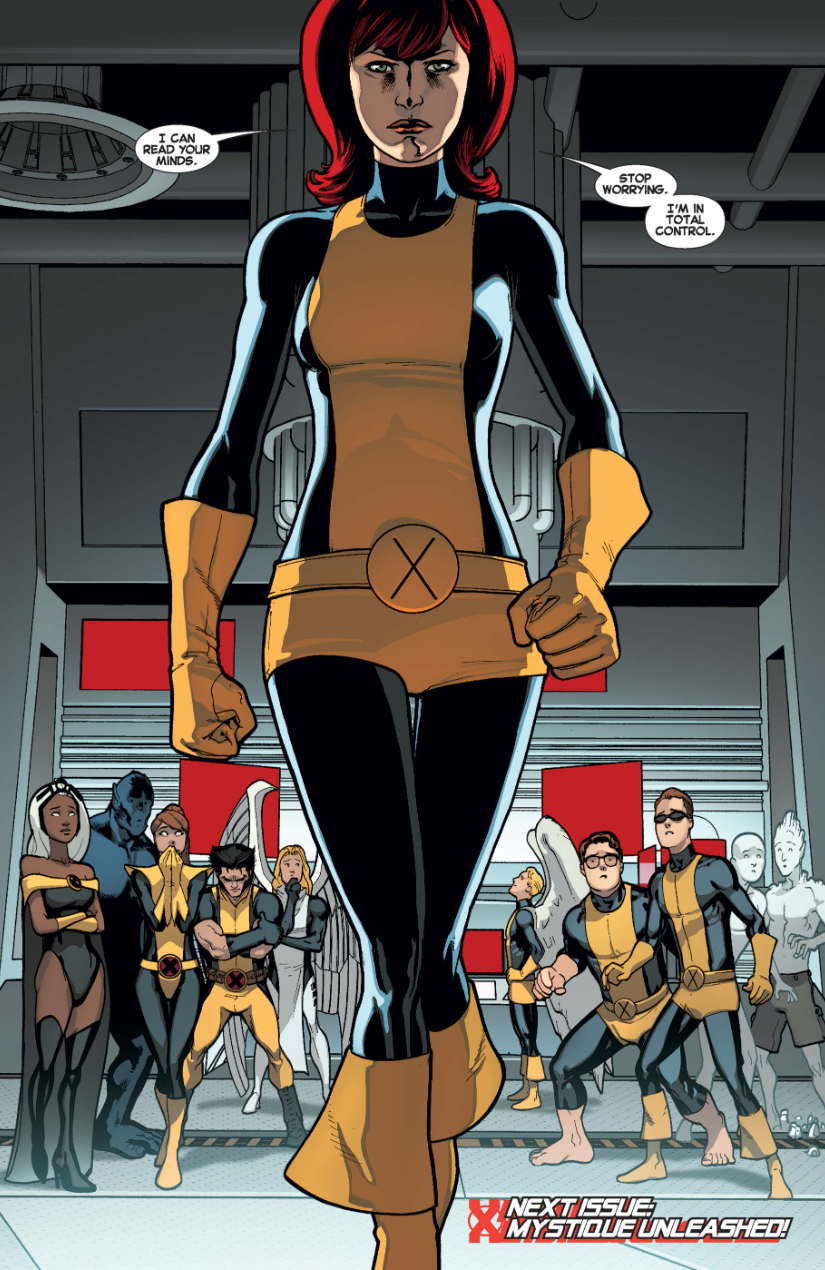
The Pheonix into Dark Phoenix saga is the macro narrative version of that. Phoenix manifesting as Jean is psychically manipulated by Mastermind into submitting to hedonistic desires. She starts becoming more aggressive with her powers. She’s acting more and more out of character. When the shielding breaks after a psychic dual with Cyclops, the Force rushes in. Jean falls to the overwhelming nature and re-emerges Dark Phoenix. The drama and tragedy of this is that Jean started as a good guy that was systematically broken down until none of her original self was left.
When a bad guy blows up a planet, that is a horrible thing that the bad guy did to show just how evil they are. But it’s not surprising. When a good guy loses their shit and blows up a planet you are now engaging in a much more interesting and complex conversation about good, evil, human nature, and the corruptive quality of absolute power.
Then there’s the argument that Brand New Day gives us a version of Jean that didn’t have Xavier’s tutelage or mental barriers. But Xavier is not the only component of Jean’s backstory.
Let’s say you remove Charles Xavier but only Charles Xavier. You’d have a teen who, after being traumatized by her best friend’s death, is rendered incapable of functioning and self-injurious by her newly unlocked telepathy. She has loving parents who are still trying their damnedest to help her (who may or may not know she’s a mutant depending on the story) and a sister with a nebulous powerset who won’t be killed by anti-mutant fanatics for another decade and change (what with the sliding timescales and all).
So, clearly, they made a lot of major changes to her backstory to create a version of Jean that had the characterizations they wanted for her in the movie. Within the confines of the movie she’s internally consistent. Everything she does makes general sense for who she’s been written as. That’s fine. It still brings us to one of the major obstacles when adapting: when you’re making this many changes, at what point does she stop being Jean Gray and start being someone completely and totally new?
From what’s been revealed of the script writing process via interviews, they came up with the idea of a mind-hopping villain first.
“There was one version of the bad guy, then another version of the bad guy. Then a version, essentially, of this bad guy that was revealed to be a very obscure character nobody had ever heard of.”
-Kevin Feige during a talk at USC
They then refined this villain to be a mentorless young person that Peter could connect to, proposed the idea of casting Sadie Sink in that kind of role, and only then did they “lock-in” that this character would be Jean Grey.
From a writing perspective, this is not starting with the character and then building the plot around them based on their natural reactions to the circumstances. This is setting up a narrative niche and molding a character into it until they fit. With comics being such a character-forward medium, this approach to adaptation risks overwriting what makes a character special.
They did it in the first Fox X-Men trilogy by shoving Rogue into the role of audience surrogate/ingénue, creating a massive divergence from her source material that doesn’t do her justice. They did it again with Mystique in the second set of Fox movies by squeezing her into a role she was never built for and not giving her nearly enough space to do any of the things that actually make her cool and interesting.
And while not nearly as grievous an offender, Brand New Day made some of the same mistakes with Jean, especially for a character they intend to keep using going forward into the Mutant Saga.
I’ve seen the argument that Jean just needs a little redemption arc and she’s a hero again. No big deal. But that that also misses the point of Jean’s arc in the source material. Redemption arcs for sympathetic villains are a dime a dozen. A heel turn is a lot more rare, particularly a good one. And Jean has one of the most famous heel turns in all of comic history. Do I think the MCU will finally be the ones to adapt it for live-action in its full scope? Probably not, let’s be real. But starting her out as a villain (even one who’s immediately reformed) certainly diminishes any impact a later re-villain arc would have for the character.
One of the prevailing themes of mutant and X-Men storylines is that it doesn’t matter if they’re “good,” people with powers can’t be trusted. Jean is a figurehead character of that theme. She’s a member of the “hero” team. She’s a good guy that came from a loving home. And that didn’t stop her from blowing up a planet. Her ongoing relationship with the Phoenix Force is one of fear and hesitancy because she doesn’t want to lose herself to it again. She’s the one who destroyed the Dark Phoenix the first time by killing herself.
Stripping that undercurrent from her removes one of her most prevalent, long-term character motivations.
I’m a Spider-Man fan and an X-Men fan before I’m a Marvel fan or an MCU fan. When Feige describes an “obscure character nobody had ever heard of” I would be comfortable betting a small sum of money I know exactly who he’s referring to. And if that’s the case, you could have absolutely done almost the exact same story without putting Jean into that antagonistic role. There could still even be a place for her in the narrative if you need her to anchor the upcoming Mutant Saga.
I recognize there is a bunch of nonsense around rights when it comes to Spider-Man that can make it difficult to get the characters that they truly want. In an ideal world, I would want the MCU to use that as an excuse to get weird with Spider-Man villains. Really and truly weird. I would unironically watch a movie where Big Wheel or Human Fly or White Rabbit is the main villain because I know they’d find a way to make them compelling.
More importantly, though, after the last two live-action Dark Phoenix sagas, Jean Grey deserves a movie truly written for her that plays to her actual narrative strengths.

 Pixels and Pins Studio